


The Importance of Time Value of Money
You’ve probably heard about the importance of time value of money.
But do you know what it really means?
What Is The Time Value of Money?
The time value of money (TVM) is a useful concept that enables you to understand what money is worth in terms of, you guessed it, time. This is expressed in a formula which basically states that money is worth more NOW than it will be in the future. This is mainly due to inflation which increases prices over time and decreases your dollar’s spending power. Many of the financial decisions we make now and in the future involve the importance of time value of money.
Examples include:
- taking out a 15 vs 30 year mortgage
- buying a car on credit (no thanks)
- investing in stocks, mutual funds or bonds
Inflation Examples
Here’s a handful of examples of how inflation increase the price on everyday items.
First Class Stamp – Back in the mid-80’s, you could mail a letter for 22 cents. That same letter today will cost you 55 cents to mail thanks to inflation.
Ticket to a movie – If you wanted to go see a movie back in 1985 such as Back To The Future or Rambo: First Blood Part 2, you’d have to shell out $3.55 per ticket. That same ticket today is right around $13.00. If you throw in popcorn and coke then you may have to borrow money from your kids!
Honda Accord – One of the most popular cars in the ’80s was the Honda Accord. Back then the base price was $8,845. Today one can be yours for $24,770.
Human Nature
It seems like kids grasp the concept of the time value of money better than adults. Don’t believe me? Try asking one if they’d rather have $100 now or pay them 10% interest and give them $110 a year later. How many would wait? I’d guess close to zero. Heck, most adults wouldn’t either!
I think that many savvy investors are starting to grasp this concept and changing the way they invest. Instead of socking away money that will be locked up in a 401K for 30+ years, they are investing for cash flow that can replace their expenses now (accumulation model vs cash flow model).
Why?
Because they want options NOW and know that buying stuff is only going to become MORE expensive each year. They’d rather have that money now rather than later.
Why Is the Time Value of Money Important?
Remember that Inflation increases prices over time so every dollar in your pocket today will buy MORE in the present than it will in the future. This makes investing even more important than most realize.
The TVM helps in that it allows you to make the best decision about how to handle your money based on:
- inflation – Inflation causes the cost of goods and services to continue to rise. You can buy more with $100 now than in twenty years. Money you have today has a higher purchasing power.
- risk – You understand that a lot can happen in the future. Due to unforeseen circumstances, you may not get all of your money, or any at all. But you can lower your risk to zero if you’re paid today.
- investment opportunity – There are a lot of ways you can make your money grow today (real estate investing). But if you wait ten years to receive your money, you’re losing the opportunity to invest.
The Importance of Time Value of Money in Real Estate Investing
You didn’t think a real estate investing blog would leave out how the TVM could help them too now did you? Real estate investors can use this concept to help determine what future cash flow from a real estate investment would be worth in today’s dollars. It can also help to determine whether you’re better off using your cash now for something such as a rehab, or borrowing money and conserving cash for another purpose.
The Importance of Compounding Interest
Even though we now know that the TVM teaches us that money is worth MORE today than in the future so we should spend it now versus save it for later; we also know that sometimes that isn’t the case. While inflation works against you, eating away at the value of your money, compound interest works for you to raise the value of your present dollar tomorrow.
What Is Compound Interest?
Compound Interest is simply earning interest on interest.
In other words, it works by calculating the interest on your entire account balance which also includes the interest that’s been accrued. Here’s a compound interest formula:
For example, if you have $1,000 and it earns 10% each year for five years, in the first year you’ve earned $100 in interest (10% of $1,000).
In year #2, things start to pick up as you’re actually earning interest on the total amount from the previous compounding period, which would be $1,100 (the original $1,000 plus the $110 in interest earned in year one).
By the end of year two, you’d have earned $1,210 ($1,100 plus $110 in interest). If you keep going until the end of year five, the original $1,000 turns into $1,610.
The Time Value of Money Formula
Now that we’ve learned what the importance of the time value of money is, how then do we go about measuring it?
We do so by using a specific formula which takes the present value, multiplies it by compound interest for each payment period and factors in the time period when the payments are made.
Formula: PV = FV / (1+I)^N
- PV: present value
- FV: future value
- R: rate of growth or interest rate
- N: number of periods (typically measured in years or months)
Using the Time Value of Money Formula
I get it. Who wants to use a complex formula? It’s essential if you want to answer questions such as:
How much would I need to save beginning today if I want to become a millionaire in 20 years, assuming a 7% growth after inflation?
You could also use this formula to calculate anticipated future costs like college, purchase of a home, weddings, etc.
If I start with with an account balance of zero today and put away $500 a month, what will I have in 10 years if I get a 6% growth after inflation?
This is a great way to see the direction you’re headed in.
Using this calculation with kids is a GREAT way to motivate them to focus on saving money at an early age.
Here’s an online calculator that you can use to speed up calculations.
Conclusion
Now you’ve come to realize the importance of the time value of money and that it tells us that money we have now doesn’t have the same value in the future. By knowing this, we’re able to make we’re able to set goals and make choices that affect our financial life.
If you would like to learn more about Multifamily Real Estate and how to invest, please email me directly at James@jcoreinvestments.com


Multifamily Market is on fire!!!
We were outbid again on a phenomenal asset in the Dallas Fort Worth (DFW) Area. It fits perfectly into our wheelhouse on every angle so we were prepared to push hard to get it.
Our initial underwriting put us at $12MM – in line with the guidance we were receiving. After some further research, we felt comfortable pushing to $12.2MM, maybe even $12.3MM if we had to. Not bad to have a few $100K to play with if need be. Our lender even mentioned we could still get 70% LTV at $12.5MM. While our returns began to take a hit at that point, it settled out in the 8% COC and 13% IRR. While that may seem a little low, you have to remember that we’re talking a home run asset in a home run market so you’re going to have to give a little with the expectation that the team and the market will allow you to outperform in the long run. Long story short the word on the street says this deal went north of $15MM before the dust settled. WOW!
With yet another crazy price in the books, we went to go back to double check our data. Are we being too conservative, are we missing opportunities with too much of a rearview mirror? We don’t think so. We think our pricing was spot on and takes into account the upside in the market. On the flip side, I also don’t think that 4-5% returns are market either (which is what the deal would have penciled at $15MM).
We’ve been tracking the market pretty closely the past few months given all the money that’s flooded into our space and have made a couple interesting observations.
First, beginning in March of this year, rental rates literally took off on a tear. We’ve been seeing healthy rental rate increases across the board for the past decade, but something happened in March to really amp that trajectory significantly. Traditionally leasing season gets underway in a serious manner around that time for southern states, but usually doesn’t get it’s stride until May or June up north. However, this trajectory was pretty consistent across all of our markets regardless of geographic location – and it’s not a small deviation, it’s massive!
Second, the spreads and rates for debt have gone to yet another record low level. Bridge debt, the more risky debt for value-add deals, which even a month ago was 4.5%, is now in the low 3% range. Lenders are practically climbing over themselves to sign up multifamily debt. While occupancy, rental rates, and collections continue to make new highs as the economy improves, we suppose it’s not too hard to understand some of the enthusiasm. This is interesting, though, considering we’re about to, hopefully, see an expiration to the eviction moratorium and potentially millions of evictions from people who have chosen not to pay rent for the past months (or year). Maybe the market has already priced in this potential downside?
In the DFW market, the average effective rent growth was 1.9% for the quarter. Yes, that’s the quarter, not the year. While Class A and B took the lions share of that rent growth, that’s still an amazing statistic. Lease concessions drove much of that increase as properties phased out previous leasing concessions that were no longer needed as demand came roaring back. We’ve seen the same in our properties as rental rates and collections reach all time highs. With new construction moderated by the inflationary situation for raw materials, this continues to bode well for stabilized assets.
All this to say, it is somewhat understandable why some buyers are throwing caution to the wind just to get their hands on a deal – especially in Dallas. And while it can be frustrating and the old FOMO (fear of missing out) can set in, we have to remind ourselves that this is a long game and these are times when it’s easy to make mistakes. We’ll continue to push forward and do the best we can to adjust our expectations (within reason) to the current market conditions, but don’t expect us to throw caution to the wind just to put another notch on the deal belt!
If you would like to learn more about Multifamily Real Estate and how to invest, please email me directly at James@jcoreinvestments.com

Why we like the Texas market
With COVID-19 cases continuing to fall and vaccination rates rising, things are beginning to feel a bit more normal. The economy is growing, and the outlook remains positive as the health crisis abates. Here’s a quick look at current conditions and our latest projections for business activity in Texas.
Texas has recovered more than one million of the nearly 1.5 million jobs lost in March and April of last year due to the pandemic. The state added 13,000 jobs in April (on a seasonally-adjusted basis) as strong gains in a few industry groups, such as leisure and hospitality and professional and business services, were partly offset by losses in construction, manufacturing, mining and logging—which in Texas is essentially oil and gas activity—and several others. The state’s unemployment rate has improved significantly, but is still above the national level. The bottom line is that while we’re moving in the right direction overall, there are still a few bumps in the road.
One issue is worker shortages, which were already a significant problem before the pandemic. Competition for knowledge workers and other skilled occupations is intense, industries such as restaurants and hospitality are having difficulty coaxing employees back, and school and childcare challenges restrain the entry of many (particularly females). Supply chain challenges also remain. The pandemic disrupted the entire global manufacturing and distribution complex, and it is quite a process to restore the relatively smooth functioning that typically supports production processes. This situation results in both cost escalation and bottlenecks that inhibit or even interrupt activity.
Our most recent forecast indicates an estimated 1.6 million net new jobs are projected to be added to the Texas economy by 2025, representing a 2.39% annual rate of growth over the period. This expansion is somewhat front loaded, as the state continues to regain the activity lost during the downturn and returns to long-term patterns. Services industries will drive job gains, with wholesale and retail trade businesses also forecast to see notable hiring. Real gross project is projected to gain $424.4 billion over the next five years, and output in all major industry groups is forecast to expand, with the mining and services segments leading the way. In particular, the energy sector is expected to continue its strong comeback.
I expect Texas to reach pre-pandemic employment levels in the next year or two. The state’s combination of natural resources, a large and growing population, and expansion in emerging industries position it well for expansion. While there are challenges ahead, such as providing the requisite education and training for future jobs and assuring the provision of essential infrastructure, Texas has the potential to remain a growth leader for the foreseeable future. Stay safe.
If you would like to learn more about Multifamily Real Estate and how to invest, please email me directly at James@jcoreinvestments.com

Return on Investments - Multifamily
In the world of real-estate syndicating, there are multiple metrics tossed around to help determine the return on potential investments. The ones I want to focus on today are the ones we use:
- Average Cash-on-Cash (CoC) Return
- Total Return on Investment
- Average Internal Rate of Return (IRR)
I will briefly mention why we use them, the pros and cons, and what to watch out for.
We will start off with the Average Cash-on-Cash return.
This is calculated by taking the cash distribution divided by the cash in the deal and averaging that out over each year of the deal.
Example: You invest $100K, receive an $8K distribution year 1, $9K year 2, and $10K year 3. Your returns over the years would be 8%, 9%, and 10% respectively and the average Cash on Cash comes in at 9%. Pretty straightforward especially for deals that do not have any refinance or return of capital events. Now, if a deal does have a return of capital events then this can get a bit tricky and a bit mis-leading.
Example: Same scenario as before except at the end of year 3, beginning of year 4 there was a refinance event that returned 75% of your capital back to you. The return for year 4 was $6K and for year 5 was $8K. Because of the refinance event, you only have $25K left in the deal yielding a cash-on-cash return of 24% year 4 and 32% year 5, creating an overall average cash-on-cash return of 16.6%. That’s a pretty great return but it definitely feels skewed a bit. Any error in the projections (good or bad) could drastically increase or decrease the CoC return after the refinance which doesn’t make this the best metric to use necessarily all the time (i.e. a $2K miss is only a 2% cash-on-cash decrease before the refinance but an 8% decrease after).
So what is ideal and what do you want to see?
Ideally you want to see a fairly strong cash-on-cash early in the deal as this lowers the overall risk of the investment because unless projections are way off, that cash-on-cash should be more stable. Note: A low average cash-on-cash return with a high total return on investment and internal rate of return generally means most of the returns will come from the exit of the investment. That means there is more risk in the investment as who knows what is going to happen between now and five, seven, even ten years down the road. A good rule of thumb is you want a good amount of the total return to be from cash on cash as that means the investment has lower overall risk.
The next metric to discuss is the Total Return on Investment.
This metric is simply telling you how much money you receive back during the life of the investment. I.e. if you invested $50K and received $100K back your total return on investment would be 100%. By itself, this metric isn’t very useful as it doesn’t give good insight on the risk of the investment nor what strategy is being used. Combined with the IRR and CoC it allows you to determine if either of those are misleadingly due to a high return of capital event. In a “straight” deal with no refinance event this will tell you the total return to expect after the set hold time but it does not account for time in the deal. In other words, this metric may tell you your money will double but at a glance it won’t tell you if that will happen in 3 years or 10 years.
So what is ideal and what do you want to see?
Ideally you want to see a fairly strong cash-on-cash early in the deal as this lowers the overall risk of the investment because unless projections are way off, that cash-on-cash should be more stable. Note: A low average cash-on-cash return with a high total return on investment and internal rate of return generally means most of the returns will come from the exit of the investment. That means there is more risk in the investment as who knows what is going to happen between now and five, seven, even ten years down the road. A good rule of thumb is you want a good amount of the total return to be from cash on cash as that means the investment has lower overall risk.
The next metric to discuss is the Total Return on Investment.
This metric is simply telling you how much money you receive back during the life of the investment. I.e. if you invested $50K and received $100K back your total return on investment would be 100%. By itself, this metric isn’t very useful as it doesn’t give good insight on the risk of the investment nor what strategy is being used. Combined with the IRR and CoC it allows you to determine if either of those are misleadingly due to a high return of capital event. In a “straight” deal with no refinance event this will tell you the total return to expect after the set hold time but it does not account for time in the deal. In other words, this metric may tell you your money will double but at a glance it won’t tell you if that will happen in 3 years or 10 years.
The final metric to discuss and is my personal favorite, the Average Internal Rate of Return.
The average internal rate of return is shown as the interest yield as a percentage expected from an investment and helps us capture distributions throughout the years as well as the time value of money. This is good because a distribution in year 1 is worth more than a distribution in year 5 of the same amount (due to the time value of money). If we factor that into the equation it helps us make good comparisons for various opportunities. See the examples below:

In these examples you can see that all investments have the same Total Return on Investment as well as Average Cash on Cash Return, however, they each have a different Average IRR. You can clearly see the benefit to IRR from receiving cash earlier on in a deal vs later. The sooner you get the money back the sooner you can put it back to work for you.
If you would like to learn more about Multifamily Real Estate and how to invest, please email me directly at James@jcoreinvestments.com

Inflation in Multifamily
For those of you who follows financial or political news, you may have seen a lot of recent chatter about inflation. Most people view high inflation as a bad thing. Just look how the cost of a cup of coffee has increased over the years. It causes the cost of goods to go up making everyday life more expensive. But how does it affect investments in apartment complexes?
I personally see inflation as a good thing in our investment space. The reason for this is the time value of money. As you may know, money today is worth more than money tomorrow. This is primarily because of inflation. If we have 5% inflation in the cost of goods a year from now, you would require $1.05 a year from now to be equal to $1 today. In addition, because we generally go with a fixed interest rate, rising inflation only serves to benefit us. Imagine a scenario where we are paying interest only on a loan of 3% and there is a 5% year-over-year inflation rate. We essentially just profited on our loan because we came out ahead on loan rate vs interest rate. This works because if I borrow a $1 from you today and owe you $1.03 a year from now, however due to inflation that money is worth $1.05 now, we just made $0.02.
Now, realistically that won’t happen because the Fed has indicated if inflation were to begin to take off, they would work hard to reel it back in, but, the higher inflation goes the narrower the gap becomes it and our interest rates which benefits us and our leveraged capital
If you would like to learn more about Multifamily Real Estate and how to invest, please email me directly at James@jcoreinvestments.com

Faith, Visualization and Belief in Attaining your Desire
We had discussed previously that DESIRE is the starting point of all achievement, but we must believe that our desire can lead us to something great! Napoleon Hill wrote that FAITH is the head chemist of the mind, stating FAITH can be induced or created through affirmation or repeated instructions to the subconscious mind. Think about Olympic athletes and their constant visualization. You can watch a ski racer, bobsledder or track star physically visualize attacking the course in front of them. This is a discipline most of them developed over time through coaching and training. Have you ever used this technique in your professional or even personal life to attain the desire that was within you?
The actor Jim Carey wrote himself a personal check in 1985 for $10 million which was dated 10 years in the future. He actually received a role in the movie “Dumb and Dumber “in 1995 for a sum of $10 million dollars. This is just another example showing that “FAITH Visualization and Belief in Attaining your desire” fits with anyone no matter what their field of interest is.
Below are some practical steps to take to Attain your Desire!
- Be specific with what you want to achieve! Do you want $25,000 a month in passive income a month? Do you want to have 1000 rental units? Be specific!
- Decide what you’re willing to give in order to achieve your DESIRE!
- Give yourself an achievement date! WRITE IT DOWN SOMEWHERE AND MAKE IT VISIBLE.
- Write out a plan and begin moving forward immediately.
- Read your plan to yourself at least twice a day and share it with someone you know that can help keeping you accountable!
Know that so many people have used Faith Visualization and Belief in Attaining your Desire before they ever reached the goals they set before them. Develop your mindset and charge after your goals!
If you would like to learn more about Multifamily Real Estate and how to invest, please email me directly at James@jcoreinvestments.com

Be Specific - JCORE's Nuggets of Wisdom
We know that desire is the starting point of all achievements! What’s next?
You are sitting in your office wherever you are in the world and you have a desire to get involved and make money with real estate. You know you have the desire to take action but you’re not sure what steps you should take.
STEP 1: Be honest with yourself!
- Do you have the desire to own a rental property?
- Do you desire to be active as a landlord while renting out your owned properties?
- Do you desire to own a property and receive income passively?
STEP 2: Be specific with your available time to commit.
- Are you looking to spend extra time working with your individually owned properties?
- Are you looking to invest with a team as a limited partner (LP) through a syndication?
Let’s be honest, most people want to increase their wealth with as little effort possible. PASSIVE INCOME! Passive income can be accomplished through investing in stocks, bonds, mutual funds and more. If you’re specific with your goals and want to earn passive income, our favorite process is investing in multi-family housing as a limited partner through the process of syndication.
Think of multi-family housing as your mutual funds of real estate. A single-family home is like an investment stock. It can earn you a decent return but when it is not performing well, you are not earning any cash flow and you’re certainly not building any wealth.
A multi-family home is similar to a mutual fund as you have several tenants within one property. They collectively pay their rent and in turn, your property’s mortgage is paid. You’re then able to earn cashflow through this investment and the property gains value through forced appreciation over time as you make improvements to the property. Ultimately, building your long-term wealth!
So, what is your specific goal?
- What amount of effort are you willing to commit?
- What amount of time can you commit?
- Do you want to actively work on growing your assets?
- Do you want to grow your wealth passively while others are working to grow your assets?
If you are interested in learning more about Multifamily investing, please email me directly at James@jcoreinvestments.com. Also you can join our JCORE Investor Club to find out about active deals we have.

Should you pay off your mortgage?
For most, paying off your mortgage is a personal decision that factors in comfort level of how much debt you have. For me, instead of paying off my mortgages, I leverage that debt to invest in more real estate. First, let me explain leverage.
What Is Leverage In Real Estate?
Greek philosopher Archimedes once said: “Give me a lever long enough and a fulcrum on which to place it, and I shall move the world.”
If you’re a home owner, then you’re well aware of what it means to use leverage in real estate. Leverage allowed you to borrow money to help finance your home in the form of a mortgage. Most millionaires and billionaires have real estate in their portfolio. Why? They know that a major advantage is something called financial leverage.
Leverage in real estate means buying property with debt instead of paying cash. This allows you to buy a much larger asset and increase the potential return on your investment than you could if you had to pay 100% of the purchase price upfront.
Now that we understand Leverage, should you pay your Mortgage off.
I say No and here’s why. Before I knew about Real Estate, my original investment strategy was to invest in index funds as it was all I knew about saving for retirement. If I put $100,000 into an index fund, then I could only purchase that amount as a shareholder. On the other hand, I could use that same $100,000 and leverage it to buy an investment property that was a much higher valued asset.
With interest rates at historical lows, there is an opportunity to use cheap debt as leverage to increase your real estate portfolio. If you currently have a property that has equity in it, you should consider pulling that equity out with a refinance and taking advantage of the low interest rates. Instead of paying off your mortgage you can apply that equity and take advantage of financial leverage. Just like I mentioned above that most millionaires and billionaires do.
Let’s take a look at how I recently used leverage as an active investor after taking equity from one of my SFH rental properties. Before refinancing this property, I was making about $350 a month in cash flow but had a high interest rate with a lot of trapped equity. After the refinance, I pulled out about $100K of equity, dropped my interest rate substantially but did reduce my monthly cash flow from $350 to $275.
You might be saying well that doesn’t make sense because you reduced your cash flow by $75 a month and took on more debt since you have to finance that additional 100K pulled out. ($75* 12 months = $900 a year in reduced cash flow). Well, let me show you how I leverage that $100K instead of paying the mortgage off of the SFH rental.
With my partners, we purchased an apartment building as a joint venture and my investment of $100K was used as a portion of the down payment to finance this asset. After all expenses and mortgage, we projected this investment will produce 13% to 15% annual (CoC) cash on cash return. To be conservative, let’s say it’s a bad year and I only make 10% return on my investment. With only 10% return that means I made $10,000 return for the year and even after considering the monthly income lost of $900 from the refinanced property, I still cleared $9100. Let’s do the math.
10,000 (CoC on $100K investment at 10% return)
-900 (reduced cash flow on refinanced SFR)
$9100 (total return after accounting for reduce cash flow from refinanced SFH rental)
This is a very simplistic way to look at this but not only did this new investment make up for the lost cash flow in the refinance, but it greatly increased my monthly returns. What else to remember is I now own 25% of a multimillion-dollar apartment building that over time will appreciate as the mortgage is also paid down by the tenants. This scenario could easily be replaced with a SFH rental investment.
And that is the magic of using leverage in real estate.
Be cautious with debt.
First off, real estate investing should be viewed NOT as a liability but as an asset that is sustainable in paying all operating cost and debt while providing cash flow. Before taking on additional debt, you need to stress test the real estate investment to understand when it goes from being an asset to a liability. For example, in this multifamily investment if it went under 60% occupied it was longer considered an asset and instead was losing money – becoming a liability. In SFH Rentals, maybe over three months vacancy is when this creates a hardship and becomes a liability. Each investment is different.
By stress testing your investment, you can better understand the right amount of debt that is manageable and what reserves are required in an underperforming rentals. Underperforming rental properties may be manageable for the near term with being over leveraged but you also need to consider a downturn in the market. You need to ask yourself what if there is a major downturn in the market and this property is making no income. Worse what if this occurs across several of your properties and you are now having to pay several large mortgages out of your own pocket.
Summary
For me, I’d rather carry debt on my real estate investing and leverage that debt to grow my portfolio. Debt is cheap right now and I highly recommend that you use the equity instead of paying off the mortgage. Just don’t get carried away in over leveraging yourself.
If you have any additional questions, please email me directly at James@jcoreinvestments.com
What's better the Stock Market or Real Estate?
Foreign Service Officers are well positions for retirement with the 3-Legged Stool – “FERS + Social Security + TSP.” The question is do you want to wait till retirement to start earning passive income. There are so many options out there to invest so what’s better the Stock Market or Real Estate?
What if I told you there is a way you can take total responsibility for your financial outcomes NOW, and can keep those fees that Wall Street & the IRS would of taken year after year from stock market investing. This Blog will provide an alternative that you may have never considered that provides immediate cash flow, higher returns with less headaches. Also very easy to manage especially while serving overseas. And NO the Stock Market isn’t going to get you there.
But what about your other investments in the stock market? Are you concerned about the future of the stock market? If so, you’re not alone. How can you possible plan for your financial future with the uncertainty and volatility of the stock market. After exploring the Pros and Cons in investing in the stock market, I’ll suggest an alternative for you to consider and NO its not Single Family Homes (SFH) either.
I know many Foreign Service Officers are purchasing SFH rentals using their disposable income while stationed overseas or turning their primary house into a rental properties to earn passive income. This is a great introduction into real estate but have you ever considered Multifamily Real Estate Investment?
Before getting in Multifamily, let’s review my I no longer invest in the Stock Market nor Single Family homes.
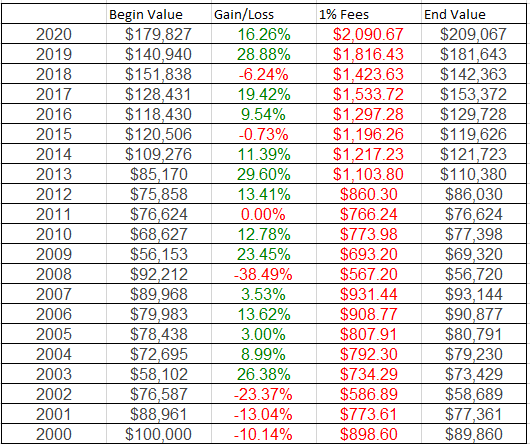
Stock Market returns will surprise you. The average stock market return over the last 20 years from the S&P 500 was 6.41% (from 2000 to 2020) and 9.65% over the last 30 years (from 1990 to 2020) [1] That means that if you invested $100,000 in 2000 it would be worth $346,456 in the end of 2020 – not bad right? But wait…not so fast.
Market volatility can crush your returns. What most investors don’t realize is that the same $100,000 isn’t actually worth $346,456 twenty years later – that’s because of the volatility of the stock market from year to year. In fact, that same $100,000 was actually worth $255,891 – which is only 4.81% return compounded every year. Not nearly as good but still not bad … until we realize these returns are BEFORE brokerage fees.
Fees stealing you blind?
The average expense ratio for actively managed mutual funds is between 0.5% and 1.0% and can go as high as 2.5% or even more. For passive index funds (ETFs), the typical ratio is approximately 0.2%[2]. Most investors have a blended portfolio of ETFs and mutual funds, so let’s assume the average fee is 1.0% per year.
After taking out a 1% fee each year, instead of being worth $346,456, your $100K invested twenty years ago is now only worth $209,066 – a mere 3.77% compounded return!
What makes it even worse is you still have to pay fees even if you lost money that year.
Let’s not forget taxes!
If you’re filing jointly and making more than $77,201, your long term capital gains rate is 15%. If you sold your entire portfolio, the taxes you’d have to pay would push your average annual return from 3.77% to 3.34%. Reducing the worth to $192,707. ($100K Initial investment + $92,707 Net Gain after 15% taxes)

Inflation – The Silent Killer
The dollar had an average inflation rate of 1.99% per year between 2000 and today, producing a cumulative price increase of 51.12%. This means that today’s prices are 1.51 times higher than average prices since 2000, according to the Bureau of Labor Statistics consumer price index. Of course, inflation silently erodes the buying power of your portfolio. So your initial investment of $100K now only has a buying power of $67,297 in today’s dollars. Compounded over twenty years, an inflation rate of 1.6% reduces your after tax return from 3.34% to 1.62% and investment worth to $150,925. Wow!!!
What does this all mean?
This means that if you invested $100,000 in 2000, your ACTUAL return, i.e. the kind of return you can actual BUY something with in 2020 dollars AFTER you pay brokerage fees and taxes is a mere 1.62% compounded per year. More specifically, after getting your initial investment back, you have $50,925 in net gains after twenty years.
I had no idea that even when losing money in the stock market I was still on the hook to pay broker fees, after pulling profits out (if any) I had to pay 15% capital gains tax while also losing value through inflation. I remember when I use to investment with Amerprise, I could never get a clear answer from them on what my real returns where and now understand why. They didn’t want me to know that the average person like you and I aren’t making money in the stock market. This is a big reason I no longer invest in the stock market and started to look for other ways to earn passive income.
What’s the Alternative? – “Real Estate”
You might be saying “That’s great, I appreciate you breaking this down for me. But what else is there? I’m so glad you asked, because some Foreign Service Officer believe that Single family Homes (SFH) is your only alternative in Real Estate. Even SFH rentals have their limits too. I’m going to show you a viable alternative to both SFH and the stock market with less risk and volatility, above average returns, lower taxes and a hedge against inflation.
Why not single family homes (SFH)?
Yes I agree there are Pros to SFH investing but it took me 15 years to realize that with my large SFH Rentals portfolio that I was limited on how big I could, that cash flow is not substantial, vacancies are costly and a hassle to manage while overseas. Ask me how I know.
SINGLE-FAMILY RENTALS
Most Foreign Service Officers, who are considering investing in real estate consider investing in single family rentals (SFH) first. What most FSO do is buy one or more SFH’s and either hire a property manager or become a landlord managing themselves. The challenge with this option is that it’s not very passive or cuts into your cash flow. Actively managing as a landlord, you’re responsible for finding the tenant, taking calls when something breaks, making repairs, dealing with bad tenants, etc. This is even more difficult while serving overseas. On the other hand, if you hire a property manager you are charged leasing fees and a monthly management fee anywhere from 8% to 10% monthly. Also, finding good property manager for single family rentals can be a challenge in itself. It is hard to get out of a contract with a bad property manager without having to pay for future earnings per the contract. That sure does eat into your cash flow and your time.
I also thought turnkey rentals would be a better option since most turnkeys are either new construction or fully remodeled properties that should have less repairs for the first few years of ownership. Also these turnkeys usually have a property manager that as already leased out the property with immediate cash flow. I think for FSO that are serving overseas, this is a good option but you are usually paying a higher price to purchase this property. Also, some of the turn keys that I’ve purchased did not provide the returns that the turnkey provided advertised.
Finally, SFH is very expensive when it goes vacancy. Not only do you lose each month’s rent payment when vacant but also there are leasing fees, utilities to pay to get a new tenant placed. This is a real problem with SFHs that might be in area with a market downturn. Look at what happened during the great recession of 2008: SFHs suddenly had higher vacancies as tenants fled into cheaper apartments and property values plummeted, resulting in a massive loss of capital.
The Alternative is Multifamily Investing or called Multifamily Syndication
What is a Multifamily Syndication? A multifamily syndication is where a group of people pool their resources to purchase an apartment building which would otherwise be difficult or impossible to achieve on their own. This typically involves the “general partners” who organize the syndication, including finding the property, securing financing and managing the property; the general partners are sometimes referred to as the “sponsors” or “operators”.
The group of people who are providing the cash investment are often referred to as “passive investors” or “limited partners”. In return for their investment, the limited partners receive an equity share in the syndication along with cash flow distributions and profits.
Benefits of Multifamily Syndication
There are 5 main advantages of passively investing in multifamily syndications over any other investments:
- Below-Average Risk
- Above Average Returns
- Passive Income
- Extraordinary Tax Benefits
- Inflation Hedge
. Below –Average Risk Perhaps the greatest advantage of investing in apartment buildings lies in its extremely low risk profile. For decades, the multifamily market has proven much less volatile than residential real estate, the stock market and cryptocurrency. When the housing bubble popped in 2008, the delinquency rates on Freddie Mac single-family loans soared, hitting 4% in 2010. By contrast, delinquency on multifamily loans peaked at 0.4%. The same can be said for 2020 and how multifamily has continued to be strong through the entire Pandemic. So, if you’re looking for a recession-proof way to invest your money, there is no better option than apartment building investing.
2. Above Average Returns As we’ve seen, the average stock market return over the last 20 years was 6.41% but after fees, inflation, and taxes that return becomes a paltry 1.6%. On the other hand, multifamily syndications routinely return average annual returns of 10% and above. That’s compounded (i.e. without volatility) and after fees, inflation, and yes, even taxes.
3. Passive Income Unlike stocks and bonds, multifamily syndications generate cashflow for its investors from the income generated by the property. This cashflow afforded by multifamily investing generates the kind of passive income that leads to financial freedom. (Can you say early retirement?) The brilliant part is that the multifamily asset itself is appreciating in value over time and can usually be sold for a significant profit. The combination of passive income and appreciation lends itself to the kind of generational wealth you can pass on to your children.
4. Extraordinary Tax Benefits Real estate has advantages over nearly every other investment, from stocks and bonds to business investments to precious metals. In Multifamily Syndication as a Limited Partner, you invest directly in the real estate and become a fractional owner of the property. This is important, because it positions you to take advantage of the other tax benefits of this profitable asset class. The biggest tax benefit to Multifamily investors is Cost Segregation.
What is Cost Segregation? In general, residential properties can be depreciated over a 27.5 year period based on their classification as Section 1250 property, but certain categories of assets within a building can be depreciated more quickly, over five, seven, or 15 years due to their reclassification as Section 1245 property. These include non-structural personal assets, land improvements, leasehold improvements and indirect construction costs, when applicable. Separating these faster depreciating assets into their proper categories allows for the frontloading of the appropriate tax deductions, lowering upfront payments and increasing cash flow. Which means you shouldn’t have to wait all those years to get a tax deduction for them.
The IRS allows multifamily investors to write off each year as an expense through something called “depreciation”. This is only a “phantom” expense, meaning it doesn’t actually cost you anything but it does reduce your taxable income. The reason for this is simple: the U.S. government wants people to invest in real estate; it’s actually a tax incentive, and it’s required by law. To illustrate the magic of depreciation, let’s look at this example.
The main thing to note here is that the $10,000 you put into your pocket is entirely tax free. Instead of showing a taxable income, your tax return shows a taxable loss. Amazing, isn’t it? You can even “carry forward” your “loss” to future years or you can use it to offset gains from other passive income – further reducing (or even eliminating) taxes in the future, too.
WOW! Do your stocks do this for you?
Depreciation is a benefit of ALL real estate investments, but multifamily gives you an additional tax bonus – called “bonus depreciation”. Recently Pass into law, bonus depreciation allows us to deduct the entire value of the investment from our taxable income in the first year. This produces a GIANT tax loss that we can carry forward and apply to other passive income – reducing our even eliminating taxes paid on any gain. And if we sell for a big profit at the end, we can do something called a “1031 Exchange” that allows us to defer taxes – indefinitely. No other investment on the planet offers such incredible tax benefits.
5. Inflation Hedge Multifamily investments are a fantastic hedge against inflation. If you recall, the Federal’s Reserve’s inflation target is 2% each year, which means everything goes up in costs, including rents. And as income goes up, so does the value of the property. I hear you saying “Yes, but no so fast. It’s true that rents are going up by 2% but so are expenses! And that keeps the net income of the property the same and with that the value of the property, isn’t that right?” Actually no … take a look at the following table that shows both the rents and expenses going up 2% each year, look at what happens to the Net Operating Income:

The Net Operating Income (or “NOI” for short) is going up! And the higher the NOI, the higher the value of the property. In fact that small 2% inflation rate results in a 10% average annual return on the cash invested in a typical real estate syndication. It’s like magic: the more inflation goes up, the more the apartment building appreciates – the perfect hedge against inflation!
The best investment no matter where you are overseas – by far – is passively investing in “multifamily syndications”.
Most investors invest their hard-earned money in the stock market. It’s not their fault, really, because that’s what 99% of financial advisors advise their clients to do! But as we’ve seen, the average annual returns of the stock market (after fees, inflation and taxes) are a mere 1.62% over the last 20 years. Coupled with the uncertainty of a market crash makes this investment class questionable at best. After studying every other possible alternative, I’ve come to the definitive conclusion that investing in multifamily syndications is the best investment on the planet. No other investment performed so well in the last recession and offers above average returns (including cashflow), extraordinary (and legal) tax advantages and a built-in hedge against inflation.
If you have any additional questions, please email me directly at James@jcoreinvestments.com

Going from a Bad Flip to purchasing 4 additional SFR (part 2)
With this bad flip, I had $285K of my own cash tied up in this Mulberry house but couldn’t sell at a price point to make a profit. I had to come up with some creative ideas to turn a bad flip into something better. Before reading this blog, read Part 1 at this link on how Mulberry became a bad flip.
Sell or Rent Mulberry
When putting the Mulberry house on the market, my realtor wanted sole rights to represent me in advertising/selling my property. We agreed and signed a contract that he would be the only realtor that could sell the property for the next 4 months. To have an escape clause, I negotiated an option to advertise Mulberry as a rental property through a separate property manager in parallel of listing the property for sell. The reason for the clause was my doubt of getting an offer over $300K needed to break even on this flip. Also, after the blood, sweat and tears my brother and I put into this house, I wasn’t sure I wanted to sell.
After receiving several purchase offers in the low $290K, I decided that I had to convert Mulberry into a rental property. Hey, I already owned 3 other SFH rentals in Texas so why not make it a fourth. Weeks leading up to this decision, I had vetted property managers and done market research on what the for rental range in the neighborhood was.
Immediately after my new property manager listed Mulberry for rent, we received many inquiries and decided to accept an offer from a tenant who wanted a 2-year lease. Of course, my realtor was not happy about this and pressured me to keep Mulberry on the market for a few more weeks since he was certain an offer above $300K would come in. Desperate for cash flow and deep down not wanted to sell, I rented out Mulberry. Of course there always has to be one more expense – purchasing a refrigerator for the kitchen since converting to a rental. Again money going out!!!
What a stress reliver to stop the hemorrhaging of money and now getting rental income coming in. I still needed to figure out how to best leverage the equity in this Mulberry flip house that was now going to be turned into a BRRR (Buy, Rehab, Rent, Refinance). In BRRR, I had already done the Buy, Rehab, Rent and only needed to Refinance my money out. The problem is closing cost add up with purchasing, selling or refinancing a house so I didn’t want to do a cash out refinance on Mulberry to turn around and purchase another SFH rental since that would accumulate two different closing cost. So, to reduce closing cost, I began to think if there was a way to do ONE closing that would allow me to pull equity out of Mulberry to purchase another.
This is where it gets a little complicated
I knew I had about $300K of equity in Mulberry and with most lenders they will only refinance up to 75% loan to value (LTV). With 75% LTV, I could leverage about $225K in equity to purchase another SFH rental. Well, I started to get even more creative and started to think what if I included one of my other TX properties (WakeBridge) valued at $265K with an exiting loan of $37K. With 75%LTV on this WakeBrdige property, I could leverage an additional $213K. (I wrote a blog about WakeBridge as my first SFH purchase at this link)
Mulberry – $300K of 75%LTV = $225K
Wakebridge – $265K of 75% LTV – $35K(existing loan) = $163K
Total equity at 75%LTV is $388K
How to make this equity go far
I started contacting commercial lenders to see if they would even entertain my creative financing idea of using the combined equity from 2 of my rental properties to provide $100K cash out and to bulk purchase other properties. To recoup from the hemorrhaging of money from the Mulberry rehab, I needed $100K cash out to resupply all my bank accounts that I drained to fund Mulberry and to also have reserves for a rainy day. Oh, to make this even a little more interesting, the bulk purchasing of the additional houses would be in 2 different state so I needed to also find a title company that could pull off doing a single closing of several properties on the same day in different states.
After negotiating with a commercial lender who was interested in financing my crazy idea, we agreed on loan terms of financing $670K (65% LTV for estimated value of property at $1.03M). This included purchasing 4 properties at combined purchase price of $499K, paying off the existing Wakebrige loan, covering closing cost and $105K cash out at closing.
When you add it all up, the closing cost for this bulk deal was $27K which comparable to a traditional residential loan was a lot cheaper. Let’s assume that on a traditional financing to purchase a SFH the closing cost averages $10K, so in this deal with 6 separate traditional closing could have been $60K . Lastly, since this was a commercial loan, it doesn’t count against my limit of only having 10 traditional residential loans in my name.
Estimated Value of Property $1,029,850.00
Number of Properties 6
Estimated Loan to Value 65.00%
Payoff of Wakebridge Mortgage $37,328
Purchase Price of properties $499,800
3rd Party Closing Costs (Title, Recordation, etc.) $6,000
Origination Fee $11,714
Processing Fee $1,750
Legal Fee $4,000
Estimated Initial Deposit for Escrow $3450
Loan Amount $669,402
Cash to Borrower at Closing $105,318
Where did the $499K Purchase Price come from?
Still licking my wounds from the Mulberry flip gone wrong, I was in no mood to do another flip or even minor repairs on a rental. Also, I needed to find several properties that I could close on the same day so started to research turnkey properties. I’ve bought turnkeys in the past and knew that they sell remodeled houses with tenants and property managers already in place.
From Bigger Pockets forum, I found a turnkey that could provide several properties at one time. Unfortunately, with this turnkey operator this was a very bad experience since they were not honest and their houses were in poor condition. After spending over $6K in property inspection, I uncovered major structure problems, poor quality in remodel and incorrect plumbing and electrical work. Again, money going out, but as the saying goes – sometimes the best deal is a deal you don’t do.
After finally walking away from this turnkey provider, someone recommended Bridge Turnkey in Kansas City MO. I’d never been to Kansas nor ever invested in this market. Bridge Turnkey was awesome in answering all my questions, providing 4 properties that met my requirements and accommodating my timeframe to close. I highly recommend them.
The 4 purchased properties
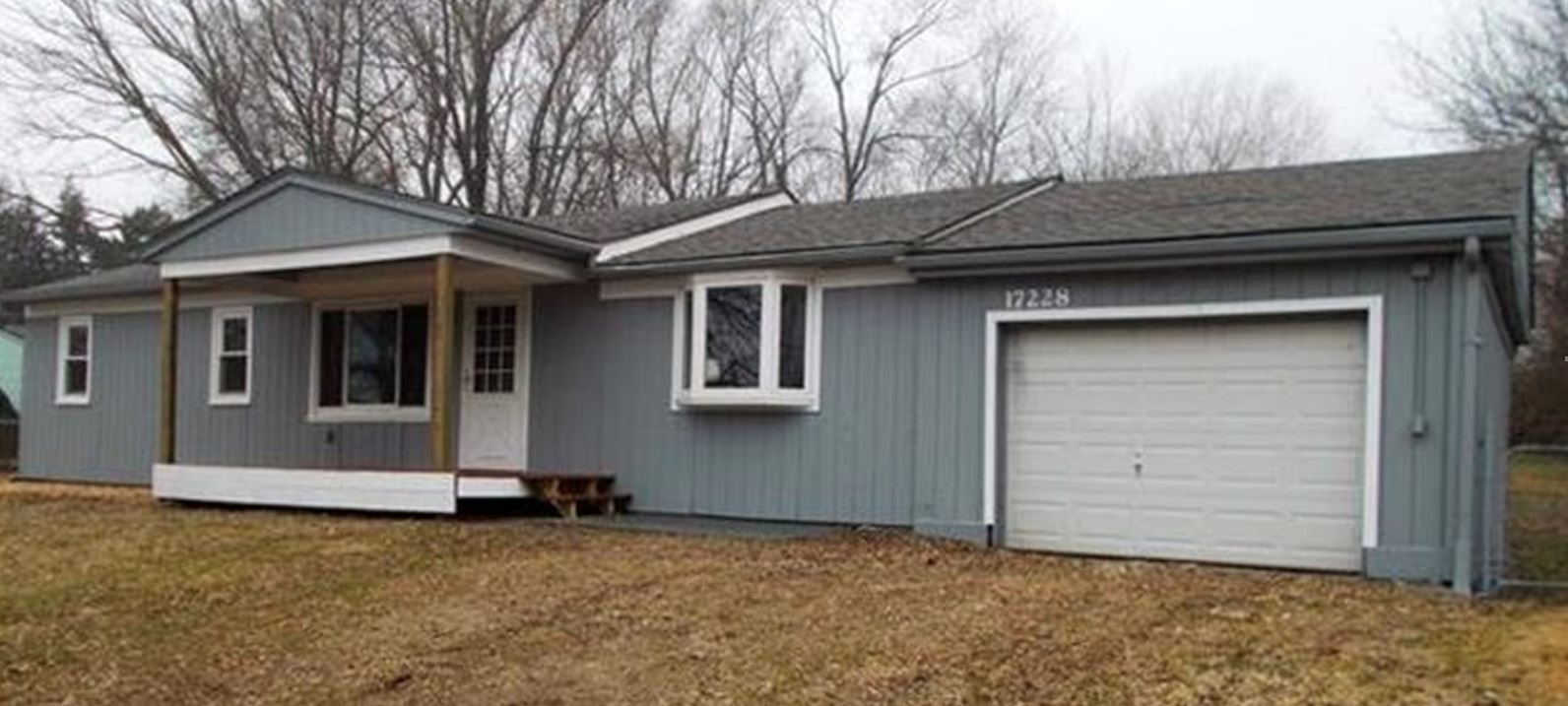
The 4 properties I selected where 3 bedroom 1 bathroom with a purchase price of $119K or $129K. Also Bridge Turnkey had a guarantee for the $119K properties to get a monthly rent range between $995 -$1050 and the $129K properties to get a monthly rent range between $1025 – $1095. Theses purchase price, rent range, fully rehabbed, being rented out and able to close on the same day fit all my requirements. Also Bridge Turnkey provided 1 year home warranty on the properties.
Kansas rental 1 $119K
Kansas rental 2 $119K
Kansas rental 3 $129K
Kansas rental 4 $129K


Summary
With the right mindset, anything is possible in real estate. It felt like every step in this journey was nothing but challenges to include rehabbing Mulberry, trying to sell, creative financing, finding a turnkey operator, etc. With creative thinking, I was able to recover from a bad flip with $105K in cash while added 4 properties to my portfolio. I also realized there is a slim chance I’ll never do a flip again. There is just to much risk compared to building equity through rentals. I can say that I gained so much experience in the rehab of Mulberry that I can over come any obstacle/road block no matter how challenging.
With this bad flip, I had $285K of my own cash tied up in this Mulberry house but couldn’t sell at a price point to make a profit. I had to come up with some creative ideas to turn a bad flip into something better. Before reading this blog, read Part 1 at this link on how Mulberry became a bad flip.
If you have any additional questions, please email me directly at James@jcoreinvestments.com

Going from a Bad Flip to purchasing 4 additional SFR (part 1)
I’m sure you love watching all the flipping shows on HGTV network. It amazes me how these shows make flipping look stress free, fun and easy while always making a profit. What I will say is flipping a house is nowhere as easy as those HGTV shows make it look.

Flip with my brother
My brother really wanted to get into the real estate business but didn’t have the capital to get started. We agreed that if he found a property, I’d fund the deal and he would be the boots on the ground to manage the rehab.
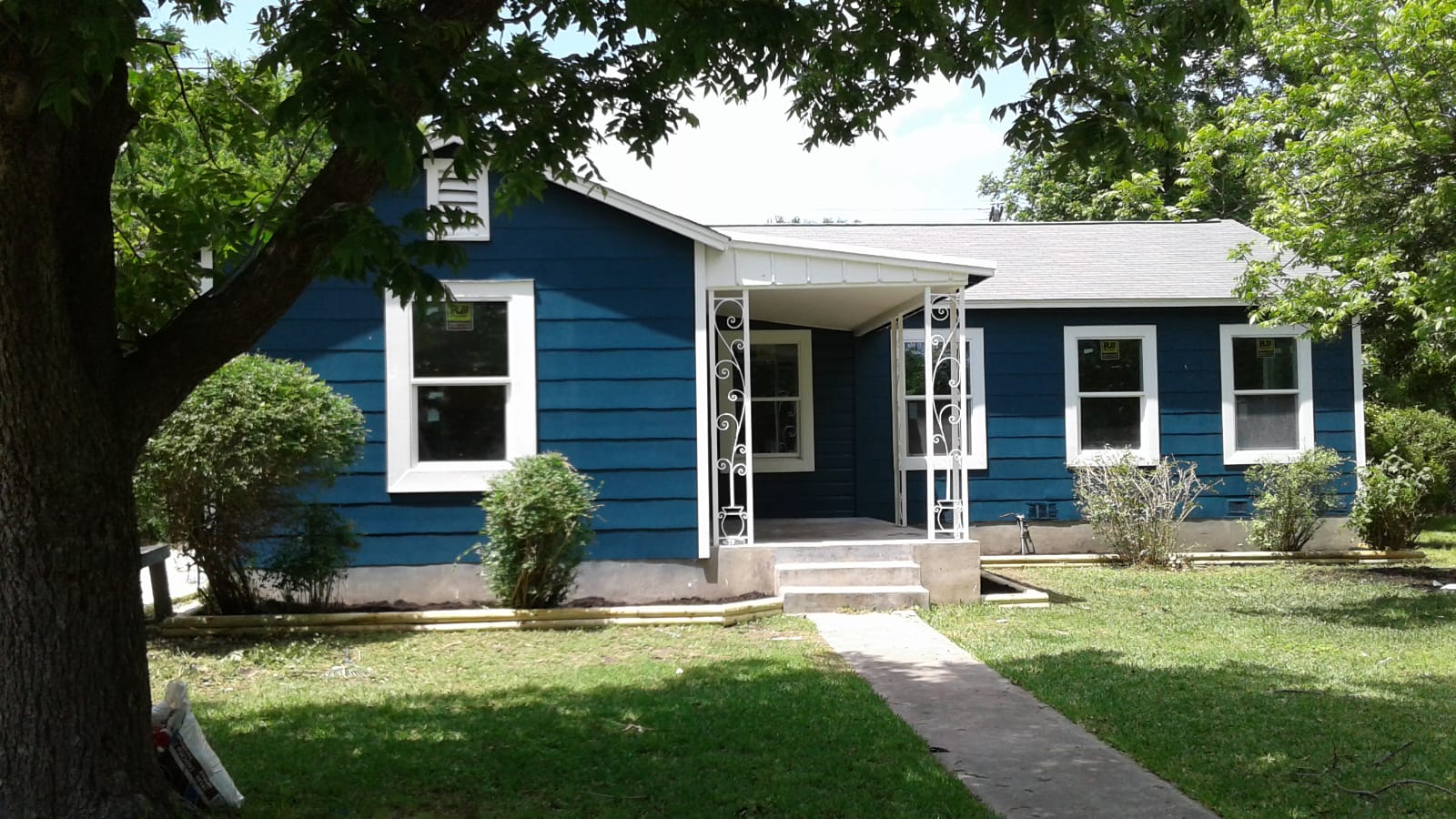
My brother lives in San Antonio and found a property that’s about 10-15 min drive from downtown San Antonio which is also a tourist area of the famous Alamo. The flip house we identified is in a very old neighborhood that was starting to see revitalization and just a few streets over had been designated as a historical neighborhood. This area was attracting young families that wanted to be close to downtown area but in a historical suburban area to raise their children.
My wife and I both love real estate and have remodeled houses in the past so were comfortable with taking on this project to help my brother out. My wife is an interior designer/space planner and an expert with AutoCAD and other software to design/plan remodels. Besides bringing capital to the project, I have prior experience in drafting scopes of works (SOW), project management and managing contractors on rehabs. My brother is a commercial electrician and also has many years of experience in constructions. As a team we were ready to take on this flip.

The Mulberry House (nickname of the project)
We purchased a 3 bedroom, 2 full bathroom house that also included a very large recreational room located on Mulberry St in an up and coming neighborhood. With Hard Money, we purchased the property at $170K plus $42K for repairs. The hard money terms was for 6 months with interest only payments at 12% which worked out to be roughly $2000.00 a month. We planned that this flip would take about 3 to 4 months so we budgeted 10K in holding cost. The total budget was $242K and with a projected appraisal after rehab of $298K. We were looking at a profit of $56K.
- $170K – purchase price
- $20K – closing cost to purchase and sell
- $42K – repairs
- $10K – holding cost


I was serving overseas so I flew back to San Antonio for closing and to also kick off the project by assisting with Demolition (Demo). I was only in town for two weeks so there was a lot of action items to put in place. Weeks leading up to closing, we had been in constant communication with our general contractor (GC) who had assisted with creating a line item on the cost of the rehab. We were still finalizing the scope of work and was planning to sign the final contract right after closing. The evening of close the GC texted my brother to say he was not taking this project and afterwards wasn’t answering his phone.
When doing a flip, there is no time to waste so we had to move quickly to find a replacement GC in such short time. We quickly signed with another GC that my brother had worked with on a different project. This was a big gamble since we didn’t fully vet this GC but decided that we had to sign since he was available to start construction right after demo. Many other GC’s said they were not available for weeks so our options were very limited.
To this day, I have no idea why our original GC backed out, but it was very eye opening to see that a person knowingly put my brother and I in such a bad position.
Downhill from there
A few days before I had to fly back overseas, our new GC realized that the foundation slab had no rebar in the concrete and didn’t think lifting the concrete slab would fix the foundation. When our original GC did the inspection of the house, he said that the crack could be fixed by lifting the foundation. At the time we never even consider that the concreate slab didn’t have metal reinforced rebar in it.
In San Antonio, foundations are a common problem in older houses so fixing this foundation didn’t seem to be a big issue at the time. What we quickly learned was that was not the case and the concrete slab was actually an old porch patio that wasn’t designed to support the weight of the current recreation room structure.
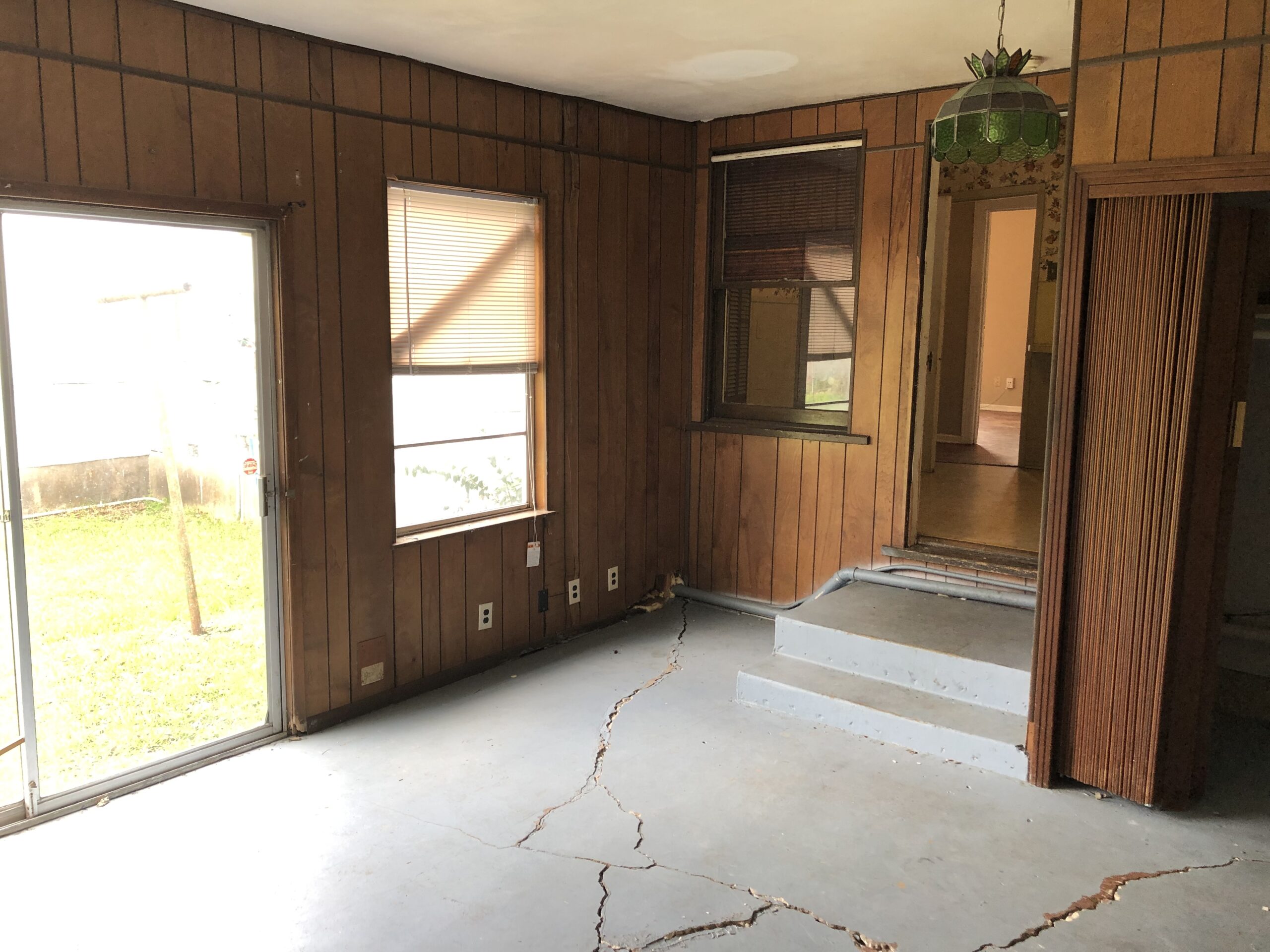

We called every foundation contractor in the San Antonino metroplex to do a site survey, give a solution and provide a price quote to hopefully salvage the current concrete foundation. Instead of hearing solutions, every foundation contractor continued to tell us what we already knew – that the recreational room was actually built on top of an old patio slab and couldn’t hold the weight of the recreation room in its current state. To add to the problem, they pointed out that the recreation room was beginning to slide off the patio slab and could possible fall when another big rain occurred. Some of the foundation contractors even presented more bad news that once the city found out about this that the city would not approve any permit repairs to this foundation. They recommended to demolish the recreation room and tired to give us quotes on building a new outside patio. The Recreation room’s square footage was planned to be reallocated into a new utility room, half bathroom, sitting area with French doors and a new 4th bedroom. This was not an option to lose this square footage since that would severally reduce the resell value by $25-30K.
Creative solution – Float the Recreation room
My brother and I continued to brainstorm and came up with an idea to float the recreation room and build a wood deck with subflooring as the new foundation. Instead of trying to fix the patio concrete slab, we decided to just leave it in place so there was no need to demo and haul away. When entering the recreation room from the house you actually stepped down almost 3 steps so there was plenty of room from the current ceiling to the current concrete floor. The question is, could we find a contractor to build a deck under an existing structure at a reasonable price. We found a company that had built a ton of decks and was surprisingly excited about taking up a challenge like this. I had already flown back overseas but was in constant communication with this contractor to get engineering drawings and permit/approval from the city.
The price quote to save the recreation room came in around $14K which we felt was a great price. The SOW included: cut about a foot and a half of the existing walls all the way around the recreation room, build supports to temporary hold the structure up, drill metal piers into the ground, install a new Glulam beams with subflooring, Install new 2×4 bottom plates on the floating walls and then properly lower the recreation room onto the new foundation. I wish I had a better video, but to the right is when the the contractor drove a small bobcat inside of the recreation room to drill down to the bedrock and install the metal supporting piers.
We literately floated the house as we built a new subfloor underneath


Old concrete stairs to enter Rec Room. On the side of the stairs is cut out concrete to install new metal pier


Above is the engineering drawings that was approved/permitted by the city to install 12 metal piers and use Glulam beams to build the subfloor on top of. Glulam beams are made by gluing together, under pressure and heat, laminates of timber that we had special order to the size we needed. The resulting product is strong, stable, and corrosion proof with significant advantages over structural steel and concrete
Here are photos as we built the new subfloor.


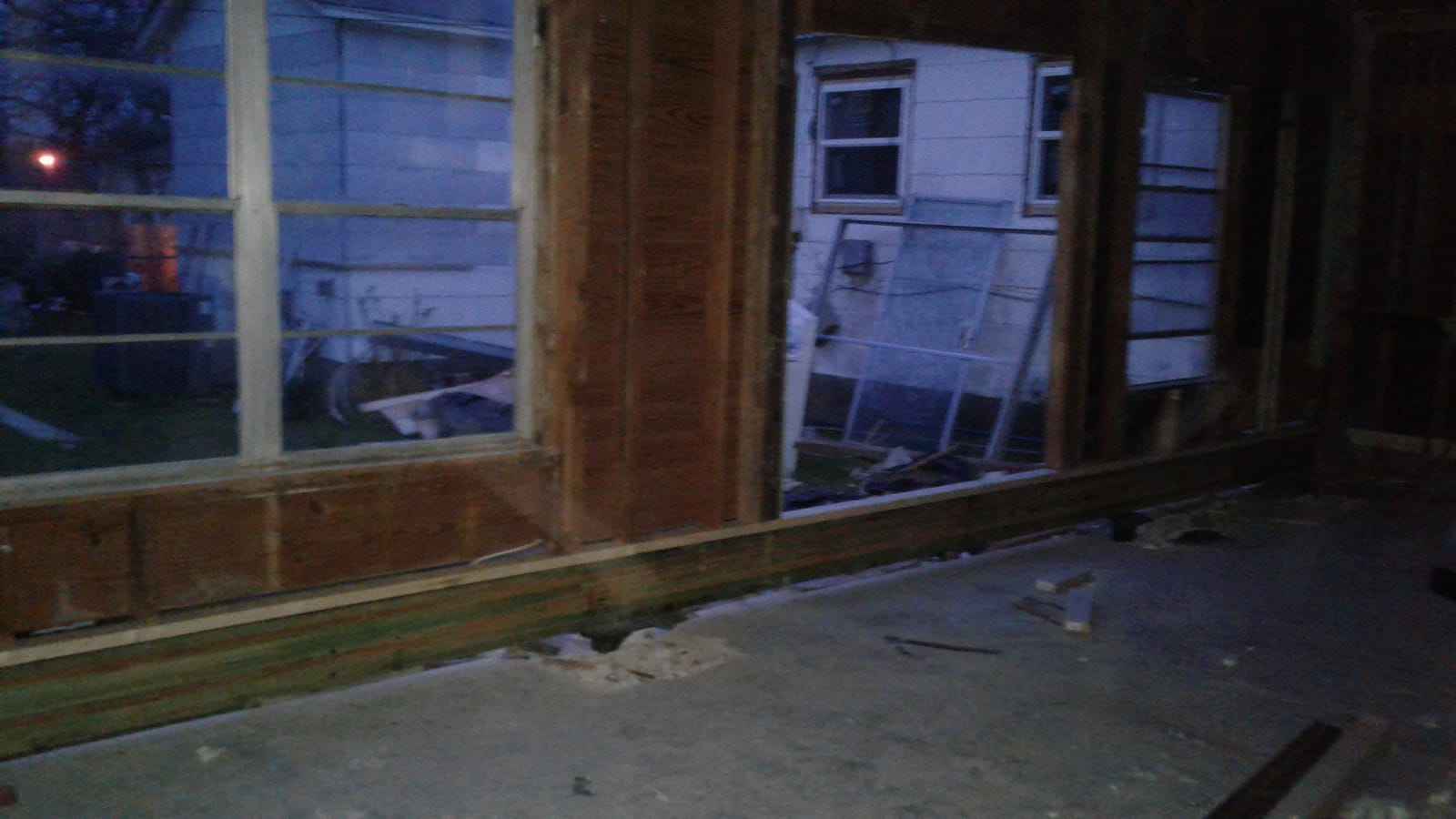


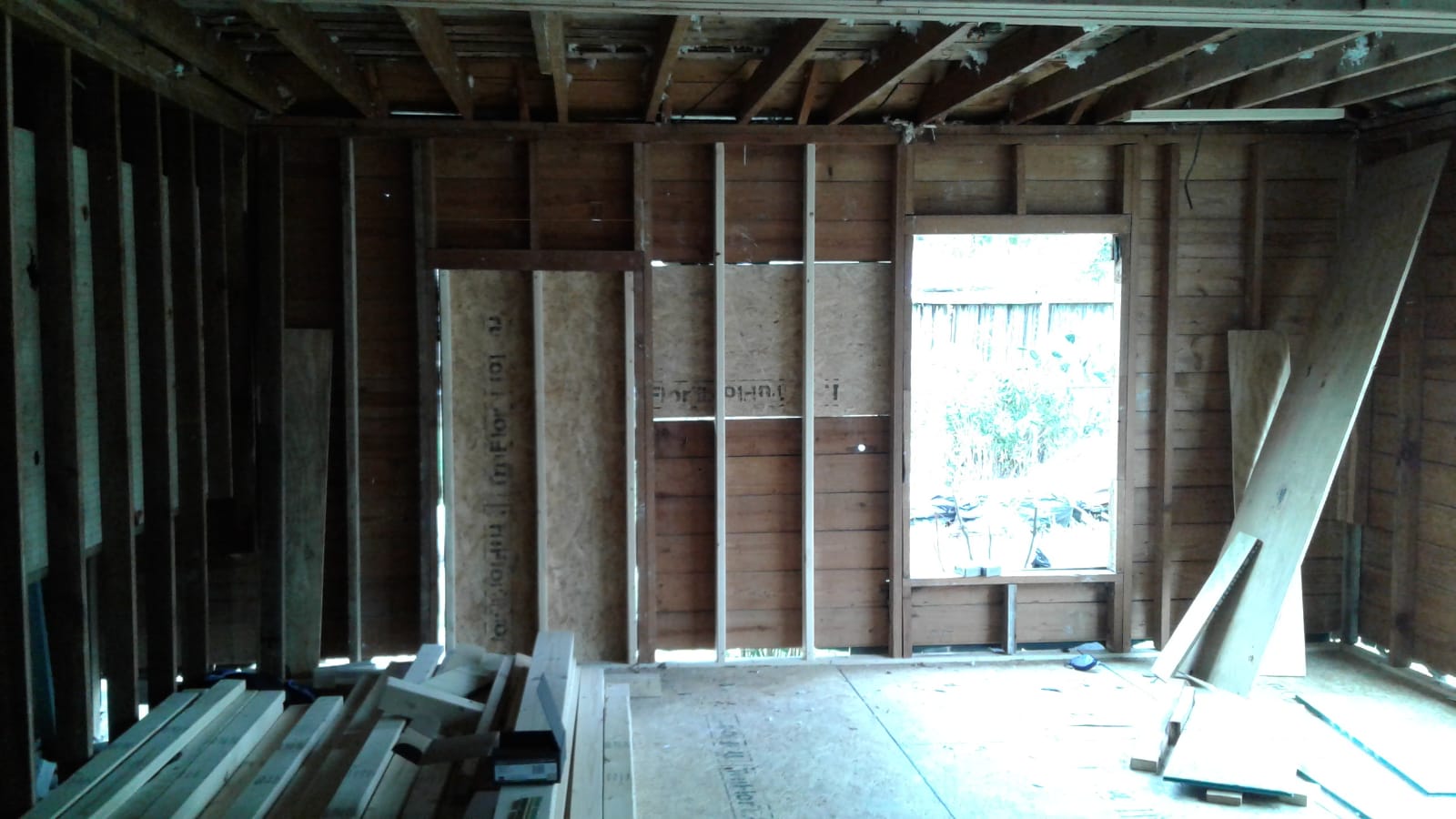
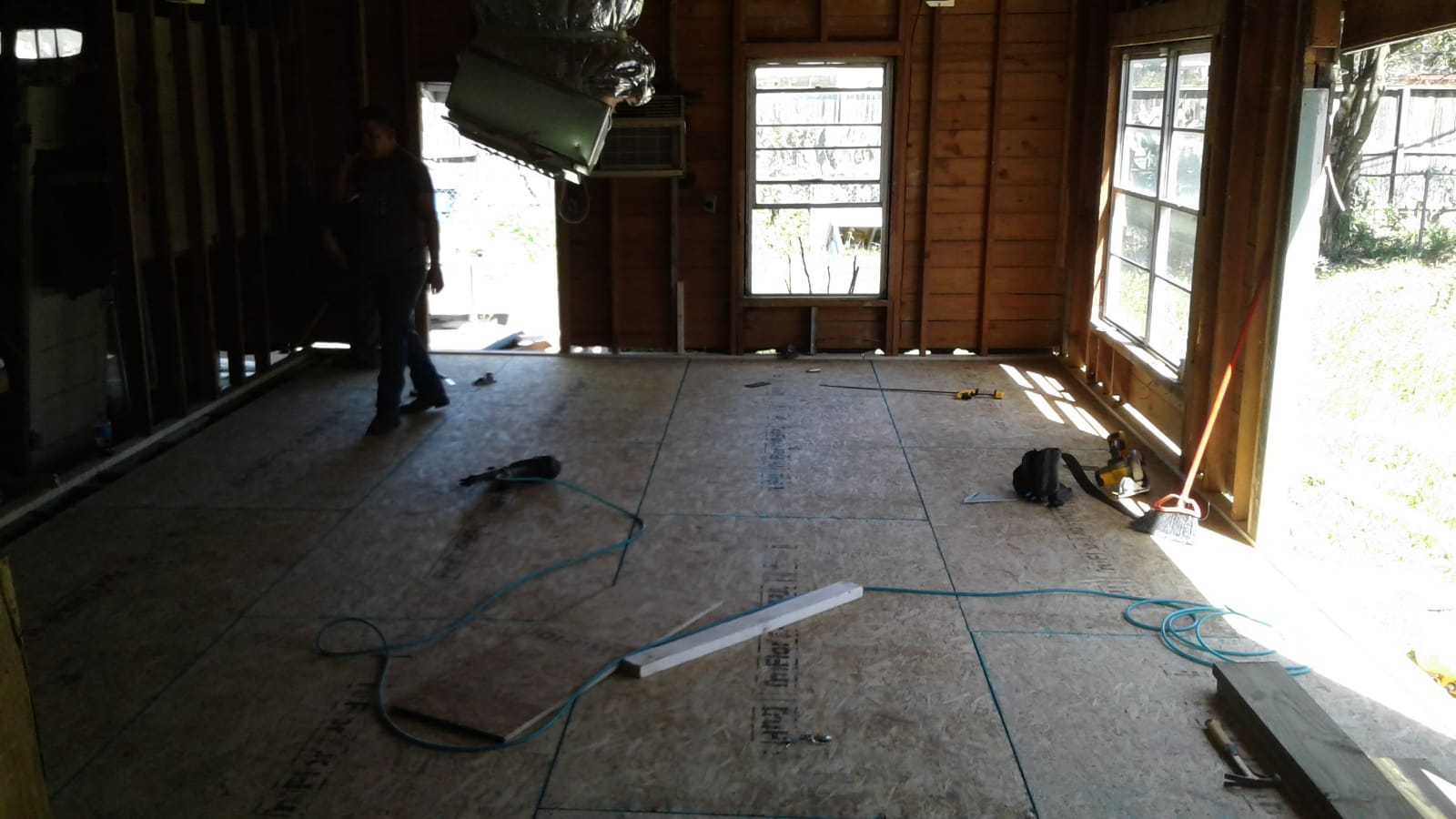
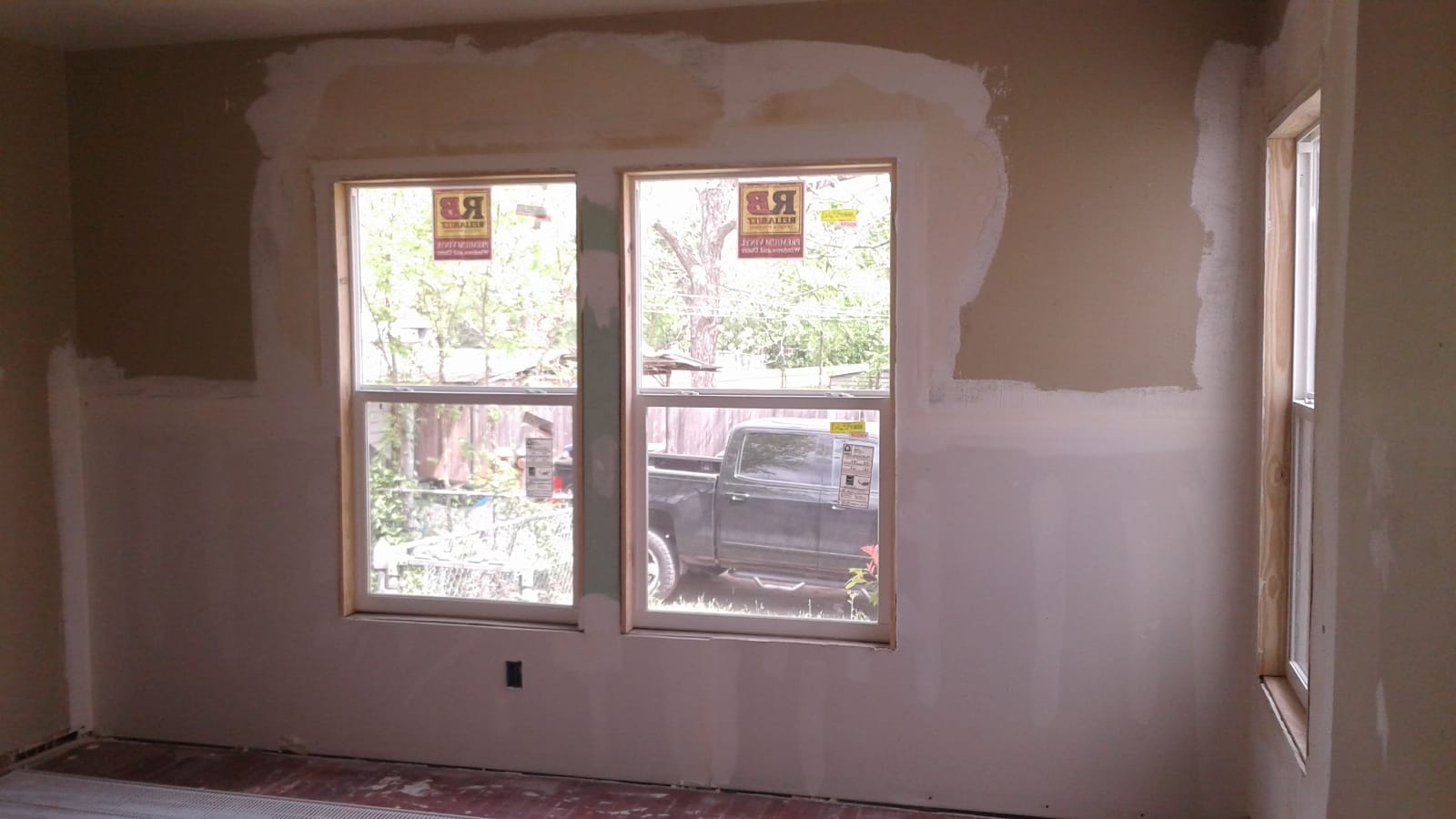
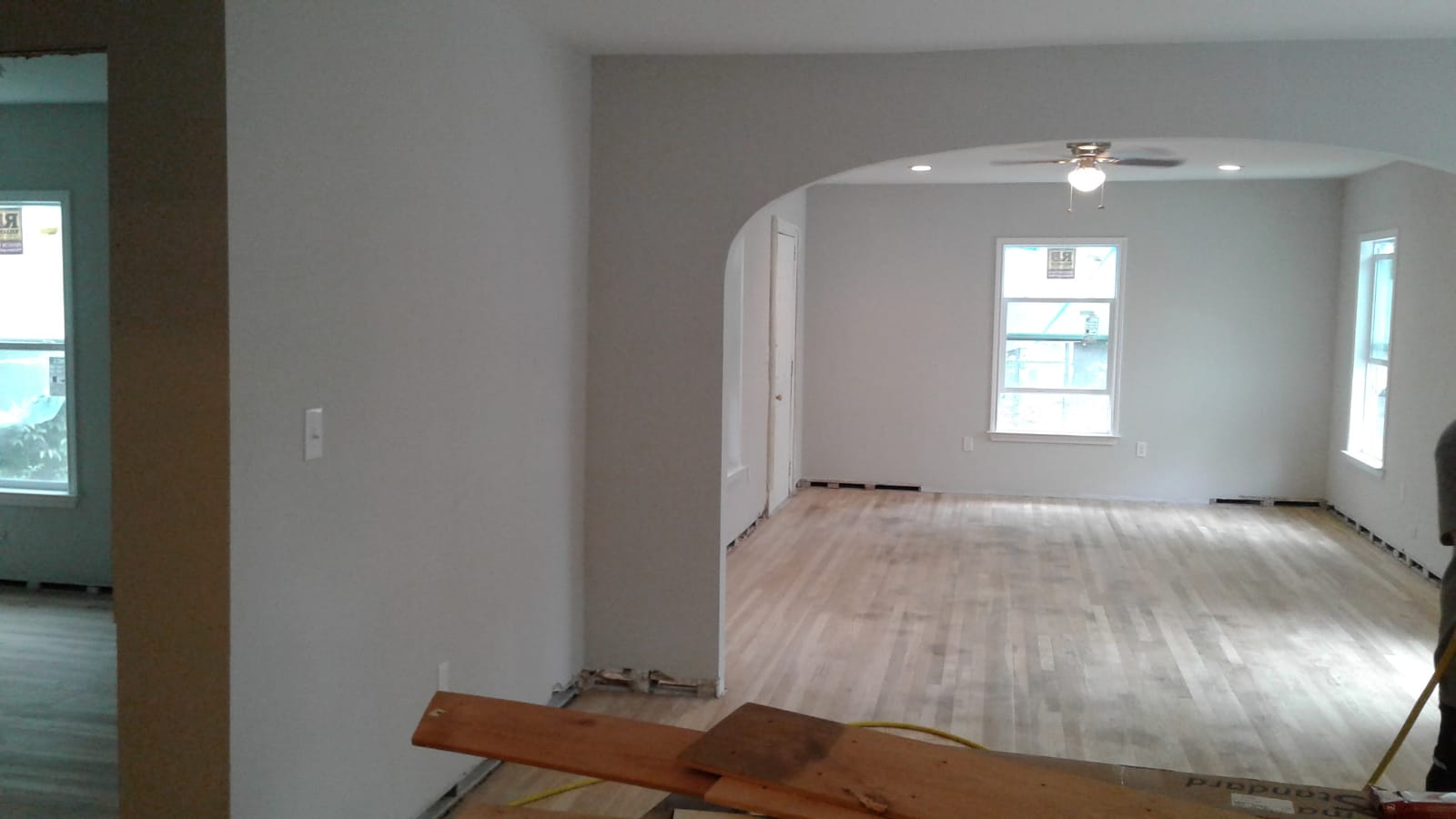
The Rest of the house was being remodeled in parallel as the subfloor for the Rec room was being built out.


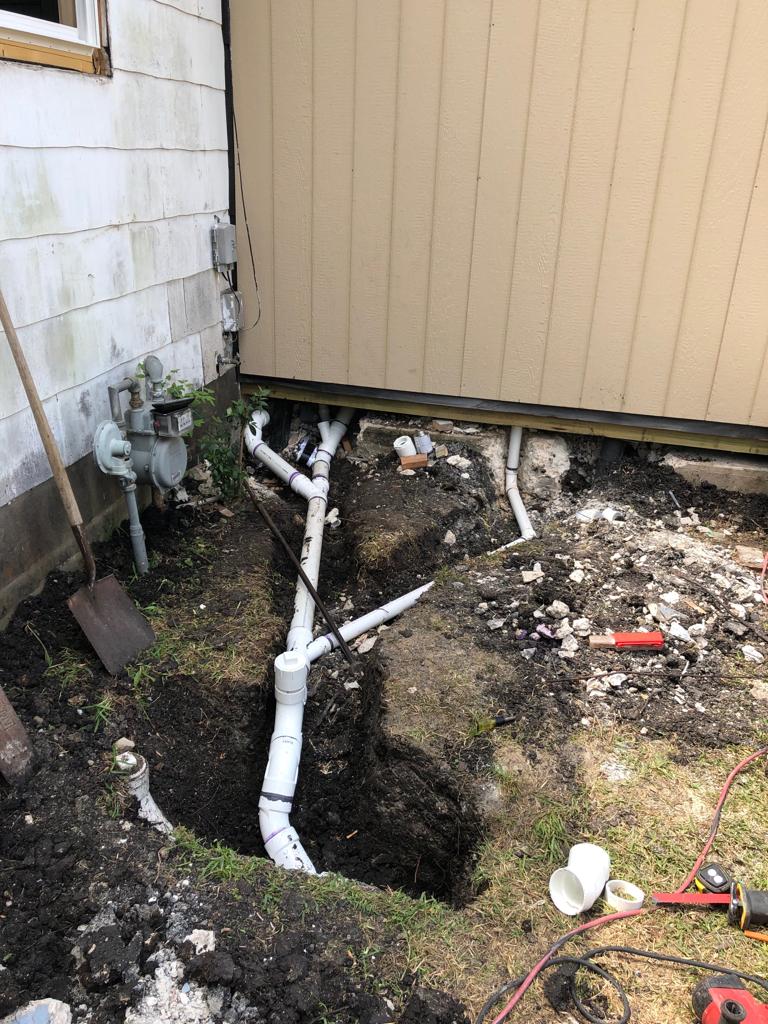


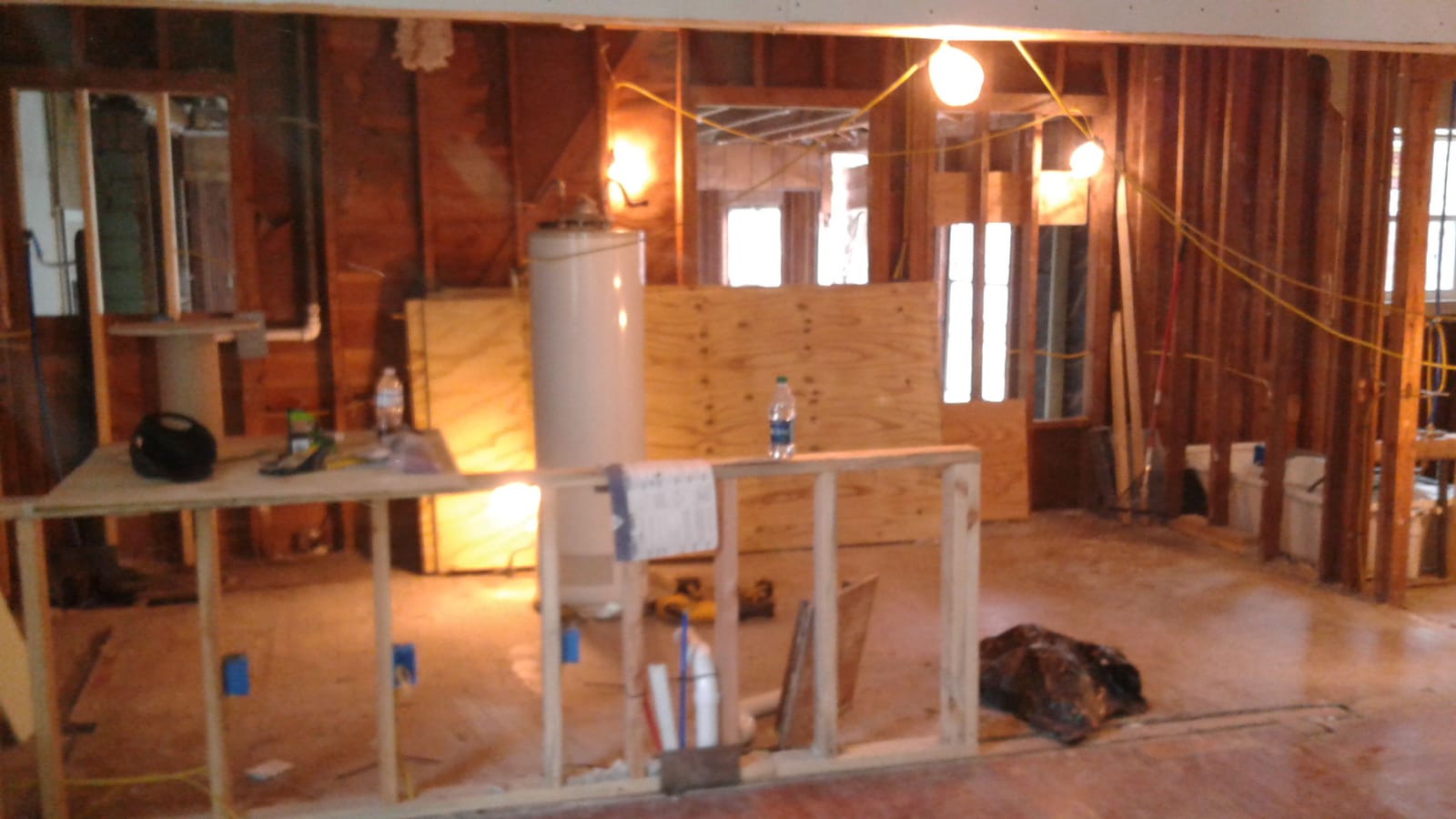








What else could go wrong?
As the project went on, we continued to find more and more problems throughout the entire house. The rehab cost skyrocketed and the contractor begin to nickel and dime us every time we did a change to the original SOW. This is also when the contractor begin to slip on the project timeline. Besides the skyrocketing cost of construction, I was stressing on having to pay more holding cost to the hard money lender and monthly utilities if the timeline continued to slipped. In the end, the Mulberry house became an entire gut job and the only thing that was not replaced was the, roof, the walls, and the HVAC system (air conditioner and heating). Even though this house was becoming a money pit, I refused to cut any corners and wanted to ensure if we found something that needed to be repaired that we did it right.


City Inspectors
When doing construction, its important to allocate time in your schedule to ensure permits are filed, approved by the city and to allow for inspections by the city at certain stages of construction. The city can shut down a construction site if they find anything that isn’t permitted, hasn’t been inspected or is out of code.
Throughout the project the city came to inspect certain items before we could move to the next stage of the project. For example, we needed the city to pass the new electrical and plumbing before we could put up any new sheet rock on the walls. The problem is you never know what inspector you are going to get and if they are going to pass you or not. A failed inspection can severely delay the project since you have to repair that identified issue and have the city come at a later date to reinspect.
One example of an inspector catching us off guard was on final electrical inspection which we thought would be in and out. The inspector said that we couldn’t use battery powered smoke detectors but instead had to have them all wired together as one system. Not a big deal but the inspector wasn’t there to inspect the smoke detectors but decided to hit us on that and not pass our electrical inspection. Not a big costly repair but we did have to purchase new smoke detectors and wire them. A completely different inspector almost gave me a heart attack since I thought this was going to bankrupted me.
After a lot of stress over the last few months, we were wrapping up cosmetic issues and about to put the property on the market for sell. I remember my brother calling me to tell me the bad news about the final/final inspection that we thought would be a formality to close all permits. During the inspection, the inspector said the original supporting beam in the recreation room was out of code by being 1 inch to low from floor to beam. The inspector then said he would put in the city record that either the beam had to be raised or the entire recreation room would need to be torn down. The picture to the right shows the beam that is just left of the French doors. As you can see that at this stage of construction to be move in ready, there was no way that the beam could be lifted 1 in
The beam that almost ended it all


I remember when my brother called me, I think my heart skipped a few beats. I was in so much shock since we were coming to an end on this project to include the amount of effort that went into salvaging the recreation room to now find out it was all a waste. After my brother calmed me down, our action plan was for him to meet with the head inspector to present our case. During the meeting, my brother explained that the city had approved the engineering drawings, there had been several inspections of the foundation and rehab of the recreation room and we felt that if this was an issue the city should have raised it at the first inspection. Also, we scrubbed the city building codes and found a line saying that if a supporting beam was not replaced then could be grandfathered in. We hoped the head inspector would interpret that code the same way since technically we were in a very gray area since the floor had been raised with a new foundation. To our surprise the head inspector agreed that the city should of told us in prior inspection and grandfathered in that beam. He closed out all permits and continued to say that if we had to tear down the recreation room that it would be bad for future revitalization in the area. He explained that he didn’t want the city to get a bad repetition of stopping investment in this area. What a great day for us.
Oh, its not over yet – Have you heard of a Mechanical Lien?
After some disagreements with our GC not meeting the timeline, we decided to hold final payment of about $500.00 back. I thought that was more than fair since per the contract the GC didn’t meet the agreed timeline and had many slips on his deliverables. We had just put the house on the market and was trying to get top dollar to at least break even. The GC knew we were under a time crunch to sell the house so took advantage of the situation by placing a mechanical lien on the house for $2500.00. With this mechanical lien, if a buyer wanted to purchase the property there would be no way to transfer the title until the mechanical lien is removed. Another option would be to sue the GC to have the lien removed but that too came at a cost and lost time. After putting my ego aside, I called the GC and explained that yes this was a tough flip but I literally had no more money and could only offer $1000.00 to settle. He agreed and the lien was removed.
Almost $285K in the hole
With the overruns of cost and time, instead of making a profit I was now hemorrhaging money. We were so over budget that we would have to sell the house over $300K just to break even. To stop the hemorrhaging, I paid off the hard money loan with reserve capital I had and now was about $285K out of pocket. At least I now owned this property free and clear. The house sat on the market for several months and only got offers at the low $290K. With closing cost, these offers would be a lose for us.
Creative Thinking to dig out of this hole
I now had $285K of equity in this house and I needed to figure out how to turn this bad flip into a positive. As for my brother, he knew this property almost bankrupted me so he felt that it was fair for me to keep full ownership of the house. I really appreciate that sacrifice from him since he put so much sweat equity into this flip. In my next Post, I’ll explain how I ended up with 4 more SFR and turned this bad flip into a win-win.
If you have any additional questions, please email me directly at James@jcoreinvestments.com

So what is it that the wealthy know that the rest of us don't?
So what is it that the wealthy know that the rest of us don’t?
They understand the incredible power of real estate. Real estate has the ability to generate passive income and provide a path toward building wealth.
One of the biggest advantages real estate creates for earners is passive cash flow. Most of us go through our entire careers focusing on and growing only one stream of income, our active/earned income. Here’s a cash flow example from an active real estate investor:
If you put down $50,000 to buy a rental for $200,000, the mortgage payment would be roughly $1,000 per month. Now let’s say that you’re able to rent it out for $2,000 per month. Upon receipt of the $2,000 monthly rent payment, you pay the $1,000 mortgage, use $700 for expenses and reserves, and keep the remaining $300 as passive cash flow (i.e., money in your pocket).
This is great but what about the busy professional that wants an extra stream of cash flow WITHOUT landlord duties (myself included)?
Enter real estate syndications. These are group investments you can invest in that purchase assets such as apartment complexes. Each one of the units is creating an income stream from the current tenants. They pay rent each month, and that monthly income flows to the owner(s). In this case it’s to the limited partners such as you, me and others without having to become a landlord.
Unfortunately, too many people are only focused on saving for retirement but not cash flow now. The good news is that they’re focused on investing but the bad news is they’re trying to save up enough money so one day they can replace their current income in order to stop working. By choosing this method, they may not ever save enough money to retire and if they do, they then have to worry about running out or being too old to enjoy it. On the flip side, every time you invest in real estate (either physical property or a passive syndication), you develop an extra stream of cash flow which moves you one step closer to your goal of income replacement.
If you are interested in earning cash flow in our upcoming Investments, click to join JCORE Investor Club.
#2 – Leverage
In the example above, you hypothetically bought a $200,000 rental without paying $200,000 in cash. Instead, you put up $50,000 as a down payment, and the bank contributed the remaining $150,000. The cash flow you earned is based on the full $200,000 asset, not the $50,000 portion. Even though the bank contributed 75% of the money, all you have to do is pay the mortgage and interest, and any excess cash flow or profit is all yours.
This is the magic of leverage.
Leverage is the use of debt to increase the potential return of an investment. Most of us are familiar with debt. Take buying a car. You can use debt to purchase a vehicle without having to come up with the entire purchase price. This is NOT something I’d recommend but is done more frequently than not. Regarding real estate investing, leverage can be used by taking out a mortgage and only putting down a fraction of the total cost. Even though you only put down a small portion of the purchase price, you are still entitled to ALL of the benefits including:
- the income generated
- build up of equity
- property’s appreciation
- tax benefits
#3 –Equity
If you’re a home owner, then you’re aware that each time a mortgage payment is made, a portion of it goes toward the principal value. This is also true regarding rental property except it’s your tenant that’s paying down the mortgage. In this way, the rental property generates income to pay for itself.
At the end of the mortgage period you’ll own the entire property, and your tenants will have paid for the majority of the cost.
#4 – Appreciation
Real estate values tend to rise over time, which means your money can also work for you in the form of appreciation. From the 1960’s through the early 2000’s there wasn’t a single year of decline in the median home price in the U.S. Appreciation is an important variable which plays a key role in defining the profit from a property for a real estate investor.
Whenever someone is considering investing in apartment complexes, they should pay attention to what improvements are being performed in order to increase the future value. For example, consider a property purchased for $580,000. In time, the duplex appreciates to $750,000, at which point it is sold. The profit at the sale, or $170,000, will have been generated via appreciation, plus any additional equity that you had built through paying down the mortgage. That being said, while appreciation is nice, it’s not guaranteed, which is why you should always invest for cash flow first and foremost, with appreciation as the “icing on the cake“.
#5 – Tax Benefits
When you invest in real estate, you get the benefits of depreciation and mortgage interest deductions, as well as a whole host of write-offs for a number of other related expenses. Depreciation is an accounting method that allows you to deduct the value of an asset over it’s useful life. Investors often show losses on paper, while actually making money through cash flow. The losses play a big part in helping to offset other income, which is a major reason real estate is so lucrative.
Further, when investing in commercial real estate syndications, you have the opportunity to take advantage of cost segregation and accelerated depreciation, further increasing your tax benefits.
If you have any additional questions, please email me directly at James@jcoreinvestments.com

Purchasing my first Single Family Home while serving overseas.
Step 1 – Take action and buy your first property.
This article will review my first SFH purchase whiling serving overseas. Even though I made a ton of mistakes on this purchase, taking the first step allowed me to grow a large SFH and Multifamily portfolio. Take Massive Action!!!
How it all Began
I joined the Foreign Service back in July 2002 which now seems like a lifetime ago. Prior to that, I severed in the USMC and never really had a lot of disposable income. In 2004, I remember while being assigned to U.S. Embassy Tel Aviv as a young single Foreign Service Officer (FSO), I mentioned to my mother that I enjoyed having so much disposable income. Wow, I thought as a FS-5, I was raking in the money.
My mom mentioned that a townhome community was being developed near where she lived and individual lots were being sold in advance of being built (my mom lives in Plano, Texas). Yes, my mother is the one who introduced me to real estate not knowing the impact that would make on my future. At the time, I seriously knew nothing about real estate, how to evaluate a deal, what cash flow is, interest rates, being a landlord, etc. I just knew I was going to buy a townhouse and call myself a real estate investor. Why not!!!
What did I actually buy?
Early 2005, I put a $10,000 deposit on a preconstruction 1850 square foot 3-bedroom 2-bathroom townhome for a purchase price of $148,914.00. (wow, where can you find that price in North Dallas, today). This was with Legacy Homes and over the next few months they sent me photos as the townhome was being built.
Closing was Nov 2005 and was through Country Wide Mortgage which used creative financing to fund my loan. Can you believe these interest rates!!! Funny story – I remember when I went to the Embassy to get my closing documents notarized, I thought that the ACS officer would explain the documents to me. She first looked at me strange for a moment before saying, “we only verify your signature and it’s your responsibility to review the documents you are signing.” Looking back, I can see how naïve I was on loan rates, terms and the closing process.
- Purchase price: $148,914
- Closing Cost: $6444
- Total Cost: $155,338
- 1st Mortgage: $119,100 6.125% at 30 years
- Subordinate loan: $22,300 8.125% at 15 years
- Cash at closing: $13,952 (minus the 10,000 escrow as deposit)
- 1st Mortgage Monthly Payments: $1126 (escrow included)
- Subordinate Payments: $214
- Total Payments: $1340
My total monthly payment was $1340. Also, at the time I wasn’t even aware of Home Owners Associations (HOA) fee, more on that later.
One thing I did right
I interviewed several property managers and asked the tough questions on how they would manage my property. After a lengthy process, I signed with Remarkable Property Manager. Looking back, I’ve worked with a ton of different property managers over the years and by far Remarkable Property Managers in Dallas are they best. To this day, they are still managing this property plus 2 others I own in the DFW Area.
Cash Flow – or actually NO Cash Flow
At the time, I thought just owning a SFH was good enough even though I was still having to pay a few hundred dollars each month to cover all expenses. This property was renting at the time for $1100.00 a month.
- Total Monthly Mortgage: $1340
- Property Manager Fee 10%: $110
- Total operating cost: $1450.00
- Monthly Rental income: $1100
- Total Cash Flow: -$350.00
Yes, you are reading that right, I had a negative cash flow on my first property. Remember my comment about HOA, previously? To make things worse, I had no idea about HOA and that there were HOA dues to be paid every quarter. About a year after purchasing this property the HOA tried to foreclose on my property since I had never made a HOA Payment. To reconcile my HOA back payments and avoid foreclosure, I had to pay $4500.00 to the HOA. So not only was I having to pay $350 a month out of pocket, I was hit with another $4500.00 a year into this deal.
Summary
I still own this property and it now makes over $350.00 in cash flow a month. I’ve also leveraged the equity several times through cash out refinancing to purchase more properties. Yes, that first deal almost ended my real estate investing career but I learned so much to be better prepared for my next investment. Even my second purchase a few years later wasn’t without mistakes but until you take the first step you will never begin your real estate investing journey.
We all say “I wish I knew then what I know now.” Well – you kind of can. Back in 2004 the online real estate community was in its infancy but now there are so many online resources and real estate communities with valuable resources. I recommend that you educate yourself and network with others in real estate to learn from their experience. I’ve found the real estate community is very helpful in providing advice and as a community wants others to succeed. If only I had that back in 2005, I wonder how different my first investment would have been.
If you have any additional questions, please email me directly at James@jcoreinvestments.com

Have you ever heard of a Self-Directed IRA (SDIRA)?
Did you know you can invest in real estate with you IRA?
Over the years, I’ve experienced that real estate is a better investing strategy for my family compared to the stock market. Even though I personally don’t like investing in the stock market, I continued to invest in an IRA for tax deferred reason. What I didn’t know is there is a thing called “Self-Directed IRA” that gives you control over where and what you can invest your IRA in.
These investments grow tax-deferred; so, earnings can compound faster than they could outside of the account. The IRS allows a wide variety of investments choices for these accounts and the one that attracted me the most is real estate.
Here are a few examples:.
- Real estate.
- Undeveloped or raw land.
- Promissory notes.
- Tax lien certificates.
- Gold, silver and other precious metals.
- Cryptocurrency.
- Water rights.
- Mineral rights, oil and gas.
- LLC membership interest.
- Livestock
The catch is you must move your IRA from your current account to a specialized firm that offer SDIRA custody services. Most of the traditional IRA account holders do not do provide SDIRA accounts and will try to talk you out of transferring your account. The reason is they are losing the fees that they are currently charging you. There are many SDIRA custodians to choose from and they also have fees so it’s important to shop around. You also need to be aware that SDIRA custodians can’t give financial or investment advice, so the burden of research, due diligence, and management of assets rests solely with you as the account holder. They are only there to ensure that when you are investing that you are following the IRS rules to keeping this a tax deferred investment.
Lastly, the most important thing to be aware of when investing in Real Estate with your SDIRA is you still could be taxed because of what is called an Unrelated Business Income Tax (UBIT). This tax comes from any of the funds that you leverage to purchase the property.
If your IRA took out a loan to purchase property, any earnings yielded from the leveraged portion of the asset (referred to as Unrelated Debt-Financed Income or UDFI) may incur UBIT. For example
- Your IRA holds a rental property. It paid cash for half and financed the other half (50%).
- The rental property earns $10,000 in a given year. Since the debt percentage is 50%, half of those earnings ($5,000) will be taxed at the current UBIT rate.
The debt percentages from each of the previous 12 months will be averaged to represent the single debt percentage for that year. Profits garnered from the sale of a debt-leveraged property will also be subject to UBIT, but not at the current Trust Rate. Such profits would be taxed as capital gains.
If you have any additional questions, please email me directly at James@jcoreinvestments.com

Do you need an Limited Liability Company (LLC)?
It really depends on your personal situation and comfort level.
First off, what is an LLC? An LLC stands for Limited Liability Company and is an entity that separates business owners and their assets from their business. When a person operates a business (rental properties) without separating themselves from the business, they essentially put themselves in a situation of unlimited liability.
If anything goes wrong (tenant gets hurt or you are sued personally) the business owner’s personal assets could be targeted in a lawsuit to award damages to the Plaintiff. But by creating a LLC, the business owner protect themselves from the threat of lawsuits, debts, and other damages.
Back to the question do you need an LLC, my recommendation is you first need to review your own situation and decide on your personal liability. For my family, there are two reasons on why we decided to created several LLC’s. The first reason is obviously “Liability” and second and even more important is “Inheritance” for my family.
I’ll start with inheritance first since it is the foundation of how my wife and I structured our business entities. My wife and I do not own anything in our name except for our personal checking accounts for day-to-day purchases. Seriously nothing!! Instead, everything that we technically own is actually legally owned by our family revocable trust that in turn owns all our assets in LLC companies. For example, our family trust owns a Holding LLC that was formed in WY and that holding LLC then owns LLC’s that were formed in the state of where our rental property is located. Side note, the reason for the Wyoming holding companies is when forming/file your LLC with WY, the member and mangers names of that LLC are never on public record. That’s ultimate privacy on the ownership of your assets.
Above is an example of the structure I use
I know this sounds complicated but the reason for this chain of ownerships through our trust and LLC’s is to avoid having to change individual ownership on our assets when life changing events happen. Why is this important you may ask? If I were to die then nothing changes on ownership of our assets but instead my wife becomes sole beneficiary of all our assets through our trust. If both my wife and I die, my kids become beneficiaries of the trust and all the assets easily pass to them. To better explain this, none of our rental property’s deeds or other assets would need to be changed/filed to move ownership to our kids if we died since everything is owned by our Trust. Also, the additional benefits is the trust has clear guidance that explains how to manage our assets if our kids are still minors. This is peace of mind for my wife and I to know that our kids are taken care of if we were to pass.
Now let’s talk about Liability. There are 2 ways to think about this when you are trying to protect your assets. One way is the asset itself – what if your tenant gets hurt on your property and they want to sue the property owner. If the property is in the owner’s name then that means all assets the owner has are up for grabs. If the property is owned by an LLC then only the assets that LLC owns are liable. The second way to think about Liability is if you are sued personally for any reason. Everything that you own under your name could now be awarded as compensation in the lawsuit. When your assets are owned by LLC’s, then you are better protected on not having to liquidate those assets owned by the LLC if you lost the lawsuit.
Going back to using a Holding LLC in WY, this is an added layer of protection because it is hard for the so called “ambulance chasing” lawyers to figure out how many assets you have. To the lawyer, if you look like you have no assets or those assets are owned by LLC’s they may not take the lawsuit since you are not an easy mark. Additional the LLC provide protection by the privacy since ownership is hard to identify.
Summary
I’ve probably convinced you for the need for LLC’s because of liability protection and inheritance but this does come at a cost. It is fairly easy and cheap to go online and create an LLC but I caution against doing that unless you fully understand what you are doing. If you do not create the LLC correctly than you might not actually have the liability protection you thought you did which defeats the purpose. I recommend instead that you discuss your personal situation with an asset protection lawyer who specialize in this even though it may be costly. The other cost to LLCs are the filing fee with the state you form the LLC in. Those cost can be different in each state and usually includes a yearly reoccurring cost. Also, you will need to pay for a registered agent in the state the LLC is formed. These costs can also range but they are a person or entity that is designated to receive mail for that LLC. Once the LLC is created there will be more fees to the county clerk to change the ownership of the deed of the rental property. Finally, with every new LLC you create the process of preparing taxes becomes more complicated. Even though the LLC may be a pass-through entity, and even if there is no money coming in or going out, you will still need to prepare K-1 that will be filed with your personal tax returns as part of your schedule C.
If you have any additional questions, please email me directly at James@jcoreinvestments.com